
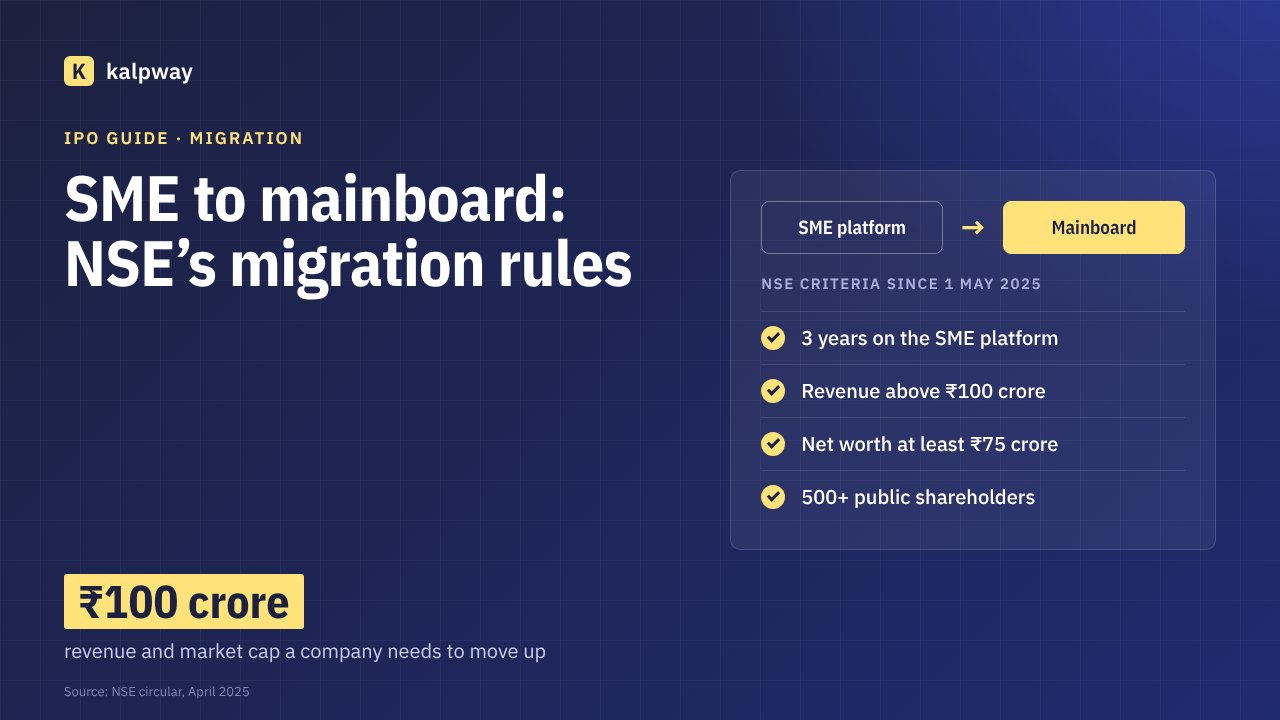
An SME-listed company can move its shares from NSE Emerge to NSE’s main board once it has spent at least three years on the SME platform and meets size, profit and governance tests. NSE tightened those tests from 1 May 2025. The key thresholds are revenue above ₹100 crore, net worth of at least ₹75 crore and average market capitalisation of ₹100 crore or more.
What are NSE’s SME to mainboard migration criteria?
NSE announced revised criteria on 24 April 2025, effective 1 May 2025:
| Criterion | Requirement |
|---|---|
| Time on SME platform | Listed for at least 3 years |
| Market capitalisation | Average market capitalisation of ₹100 crore or more |
| Revenue | Revenue from operations above ₹100 crore in the last financial year |
| Profitability | Positive operating profit in at least 2 of the last 3 financial years |
| Net worth | At least ₹75 crore |
| Paid-up equity capital | At least ₹10 crore |
| Public shareholders | At least 500 on the date of application |
| Promoter holding | At least 20% at application, and not below 50% of the holding at the time of SME listing |
What other conditions apply?
- No insolvency proceedings under the IBC and no winding-up petition admitted by the NCLT.
- No material regulatory action, such as a trading suspension, against the company or its promoters in the last three years.
- No director disqualified or debarred by a regulator.
- No pending investor complaints on SEBI’s SCORES system.
- No defaults on interest or principal to debenture holders, bondholders or fixed deposit holders by the company, its promoter or its subsidiary.
- A two-month cooling-off period if the shares were recently moved out of the trade-for-trade segment or faced other surveillance action.
How common is migration?
The Economic Survey 2025-26 reported that more than 1,380 companies have listed on India’s SME platforms since they were launched, and around 350 of them have moved to the main board. In other words, roughly one in four SME-listed companies has made the move so far.
Is migration compulsory when an SME company raises more capital?
Not any more. Earlier, a further capital raise that took post-issue paid-up capital above ₹25 crore triggered mandatory migration. Under SEBI’s 2025 amendments, an SME-listed company can raise further capital and stay on the SME platform, as long as it complies with the disclosure and governance rules that apply to mainboard companies.
Why would a company migrate?
- Wider investor base. Main board shares trade in smaller lots, which opens them to more retail and institutional investors.
- Liquidity. Trading volumes are usually higher on the main board.
- Index and fund eligibility. Some institutional mandates and indices consider only main board stocks.
The trade-off is a heavier compliance load and closer scrutiny.
Does BSE use the same rules?
No. BSE SME has its own migration criteria. Companies listed on BSE SME should check BSE’s current circulars before applying.