
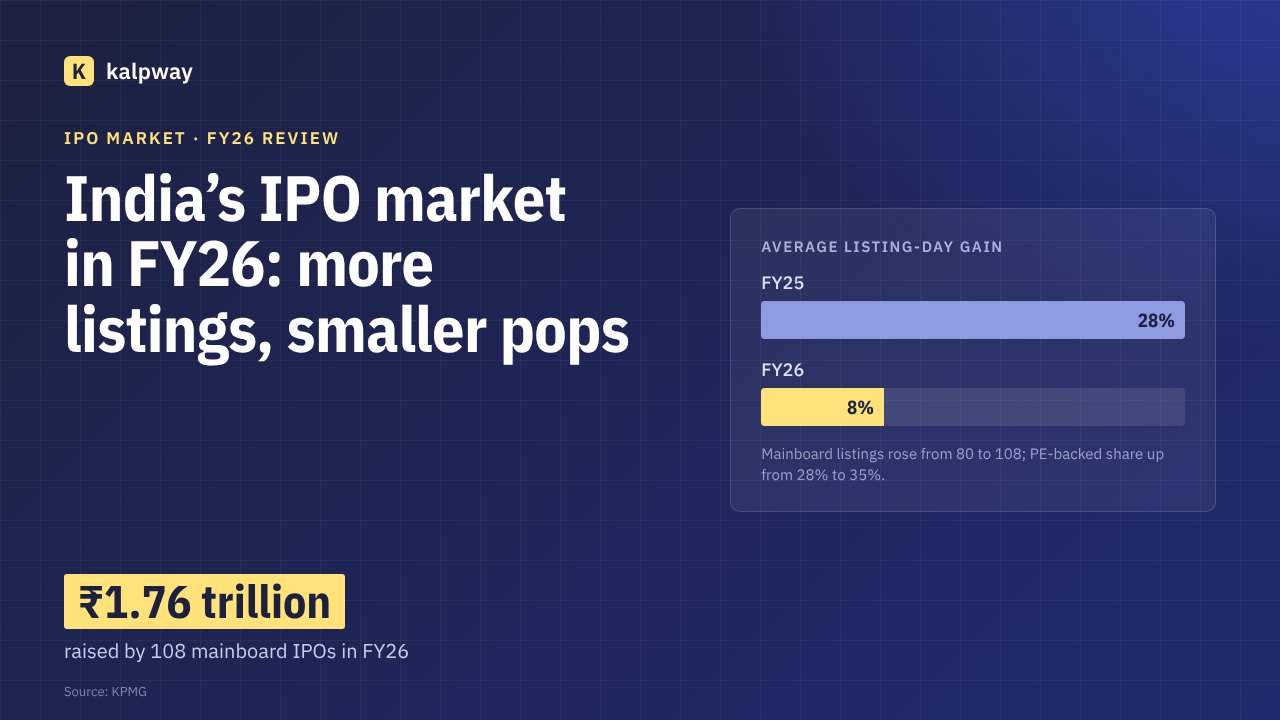
India’s mainboard IPO market had its busiest year by number of listings in FY26 (April 2025 to March 2026): 108 companies raised ₹1.76 trillion, according to KPMG in India. Money raised was close to FY25’s level, but investors became more selective — the average listing-day gain fell to 8% from 28%.
FY26 IPOs in numbers
| Measure | FY25 | FY26 | Source |
|---|---|---|---|
| Mainboard IPOs | 80 | 108 | KPMG |
| Amount raised (mainboard) | ₹1,630 billion | ₹1.76 trillion | KPMG |
| PE-backed share of listings | 28% | 35% | KPMG |
| Average listing-day gain | 28% | 8% | KPMG |
| All IPOs incl. SME | — | 366, about ₹1.9 lakh crore | Grant Thornton Bharat |
₹1.76 trillion is ₹1.76 lakh crore. NSE’s own count for the mainboard over April 2025 to February 2026 was 99 IPOs and ₹1.65 lakh crore, against 79 IPOs and ₹1.62 lakh crore in FY25 — small differences from KPMG’s figures that come from counting methods and dates.
Who raised the money?
Financial services led. NSE’s March 2026 market report said financial services companies accounted for 34% of mainboard IPO fundraising in April 2025 to February 2026.
Private equity sold more. PE-backed companies made up 35% of mainboard listings, up from 28% in FY25. KPMG reads this as investors using strong market conditions to exit.
Why did listing gains shrink?
The average listing-day gain fell from 28% to 8%. KPMG attributes this to subscribers taking a more cautious and selective approach to new issues. Fundraising stayed close to FY25 levels, so investors kept putting money into IPOs but were choosier about price.
How did SME IPOs compare?
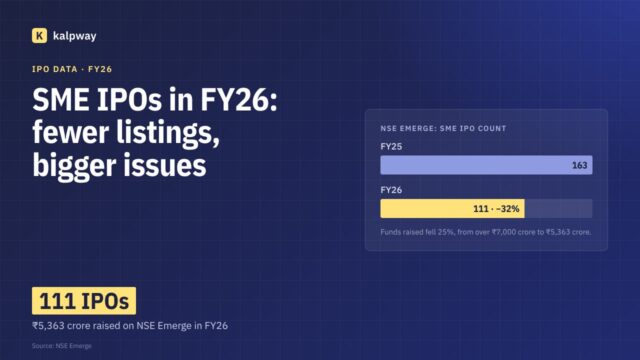
SME IPOs moved the other way. On NSE Emerge, the number of SME IPOs fell 32% to 111 in FY26. Including BSE SME, Grant Thornton Bharat counted 258 SME IPOs raising about ₹12,030 crore. See SME IPOs in FY26: the data.
How has FY27 started?
More slowly. KPMG counted eight mainboard IPOs raising about ₹50 billion in Q1 FY27 (April to June 2026). PE-backed companies made up 38% of listings, and offers for sale were 28% of issue proceeds. KPMG pointed to a strong pipeline of large issues and expected activity to pick up as geopolitical concerns ease.
What to watch
- Whether the large-issue pipeline converts into listings in the second half of FY27.
- Listing-day performance, as a signal of how selective investors remain.
- The share of offers for sale, which shows how much money goes to existing shareholders rather than the company.
Follow individual issues on the Kalpway IPO Tracker.