
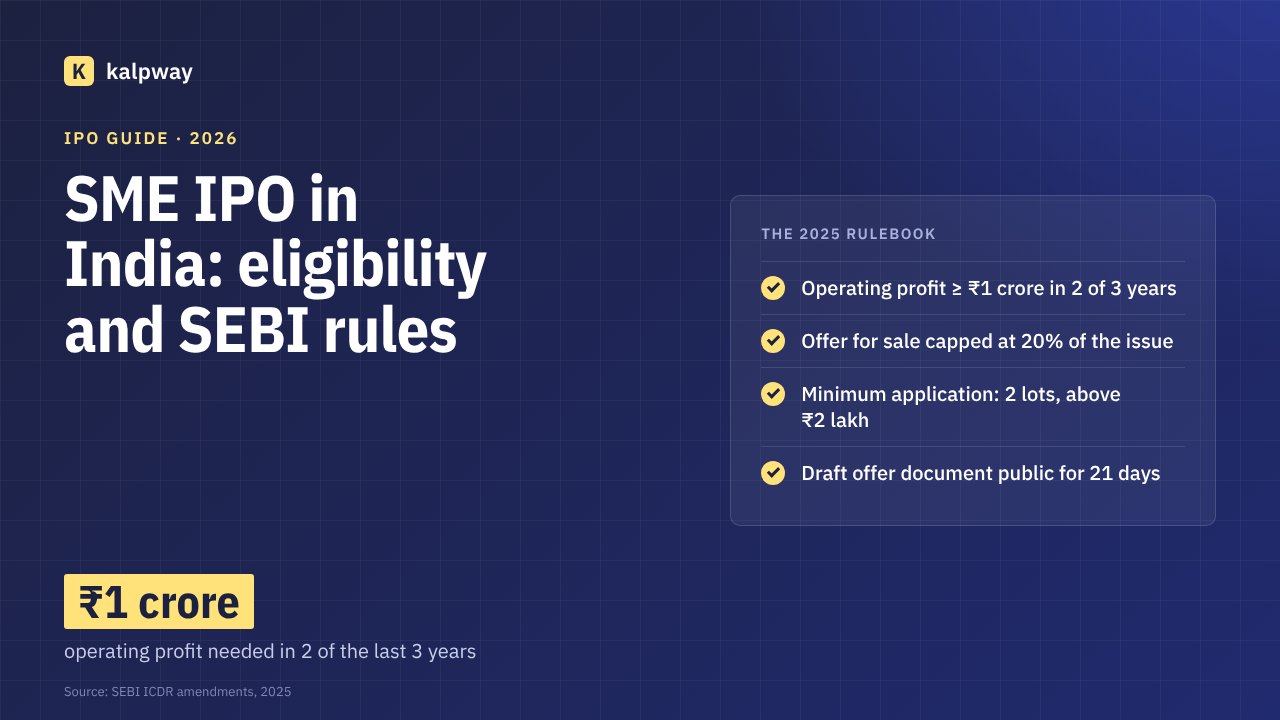
An SME IPO is a public share issue by a small or medium-sized company on a dedicated SME platform — NSE Emerge or BSE SME — rather than on the main stock exchange board. The rules are lighter than for a mainboard IPO, but SEBI tightened them in 2025: companies now need a record of operating profit, sellers can offload only a limited stake, and the minimum application is higher.
What is an SME IPO?
An SME IPO is the route through which a smaller company first offers its shares to the public and lists them on an SME exchange platform. India has two: NSE Emerge, run by the National Stock Exchange, and BSE SME, run by BSE. The platforms exist because the mainboard’s size, disclosure and compliance requirements are hard for small businesses to meet, while those businesses still need access to equity capital.
The trade-off is that SME shares trade in larger lots, have fewer participants and are usually far less liquid than mainboard shares. That is why the rules lean heavily on minimum investment sizes, mandatory market makers and, since 2025, profitability tests.
Who is eligible for an SME IPO on NSE Emerge?
Each SME exchange publishes its own eligibility criteria. NSE Emerge’s current criteria, as listed on its website, are summarised below. BSE SME has its own, broadly similar list, so issuers should check the exchange they plan to use.
| Criterion | NSE Emerge requirement |
|---|---|
| Incorporation | A company incorporated in India under the Companies Act, 1956 or 2013 |
| Size | Post-issue paid-up capital (face value) of not more than ₹25 crore |
| Track record | At least three years for the company, its promoters or the firm it was converted from |
| Promoters | At least three years’ experience in the same line of business and at least 20% of post-issue equity |
| Profitability | Operating profit (EBITDA) of at least ₹1 crore in any 2 of the 3 previous financial years |
| Cash flow | Positive free cash flow to equity in at least 2 of the 3 previous financial years |
| Net worth | Positive |
| Clean record | No insolvency proceedings admitted, no winding-up petition admitted, and no material regulatory action in the past three years |
The criteria must be met both when the offer document is filed with NSE and when it is filed with the Registrar of Companies and SEBI.
What did SEBI change in the 2025 SME IPO rules?
SEBI’s board approved a revised SME framework on 18 December 2024, after a consultation paper in November 2024. The changes to the ICDR Regulations were notified in March 2025. The main changes were:
| Area | Rule from 2025 |
|---|---|
| Profitability | Operating profit of at least ₹1 crore in any 2 of the 3 preceding financial years |
| Offer for sale (OFS) | Capped at 20% of the total issue size; each selling shareholder can sell no more than 50% of their holding |
| Minimum application | Two lots, with the application worth more than ₹2 lakh |
| Use of proceeds | Money raised cannot be used to repay loans from promoters, the promoter group or related parties |
| General corporate purposes | Capped at the lower of 15% of the amount raised or ₹10 crore |
| Public scrutiny | The draft offer document must be available for public comments for at least 21 days |
| Promoter lock-in | Release of promoter holdings above the minimum contribution is staggered: half after one year and half after two years |
| Non-institutional investors | Allocation follows the mainboard method instead of proportionate allotment |
SEBI also extended the mainboard rules on related party transactions to SME-listed companies, and allowed SME-listed companies to raise further capital without being forced to migrate to the mainboard, provided they follow mainboard-level disclosure rules.
How does the SME IPO process work?
- Appoint a merchant banker. The lead manager carries out due diligence, prepares the offer document and must ensure the issue is fully underwritten.
- Prepare restated financials and the draft offer document. The draft sets out the business, risks, financials, objects of the issue and the offer structure.
- File with the SME exchange. The exchange reviews the draft and the company’s eligibility. The document is also filed with SEBI.
- Public comments. The draft is published on the exchange and lead manager websites for at least 21 days.
- Appoint a market maker. SME issues must have a market maker to provide two-way quotes after listing.
- File the final offer document with the Registrar of Companies, announce the price band and open the issue for bidding.
- Allotment and listing. Shares are allotted and listed on the SME platform.
How is an SME IPO different from a mainboard IPO?
| SME IPO | Mainboard IPO | |
|---|---|---|
| Platform | NSE Emerge, BSE SME | NSE and BSE main boards |
| Draft review | SME exchange | SEBI issues observations |
| Company size | Post-issue paid-up capital up to ₹25 crore (NSE Emerge) | Larger companies |
| Minimum application | Two lots, above ₹2 lakh | One lot, typically ₹15,000 or less |
| Market maker | Mandatory | Not required |
| Liquidity | Usually low | Usually higher |
Can an SME-listed company move to the mainboard?
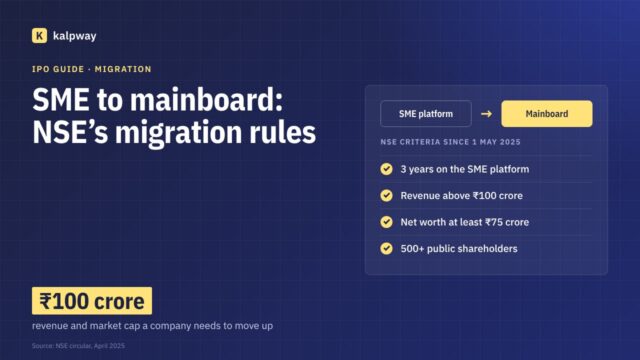
Yes. Companies that grow can migrate to the main board if they meet the exchange’s migration criteria. NSE raised the bar from 1 May 2025, including at least three years on the SME platform and revenue above ₹100 crore. See our explainer on SME to mainboard migration rules.
Where to track SME IPOs
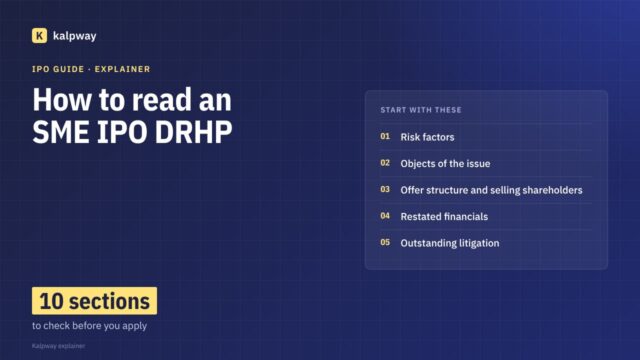
Kalpway’s IPO Tracker lists SME and mainboard issues with dates, issue sizes and links to the offer documents. For a guide to reading those documents, see how to read an SME IPO DRHP.