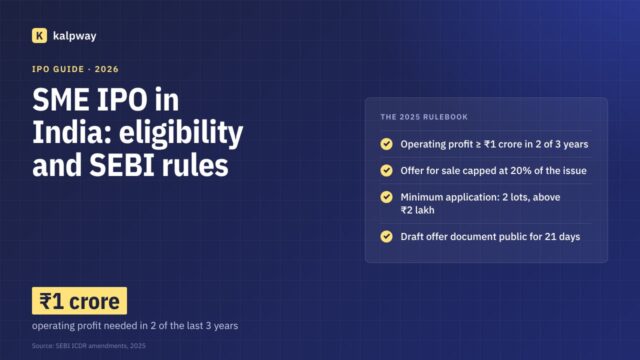

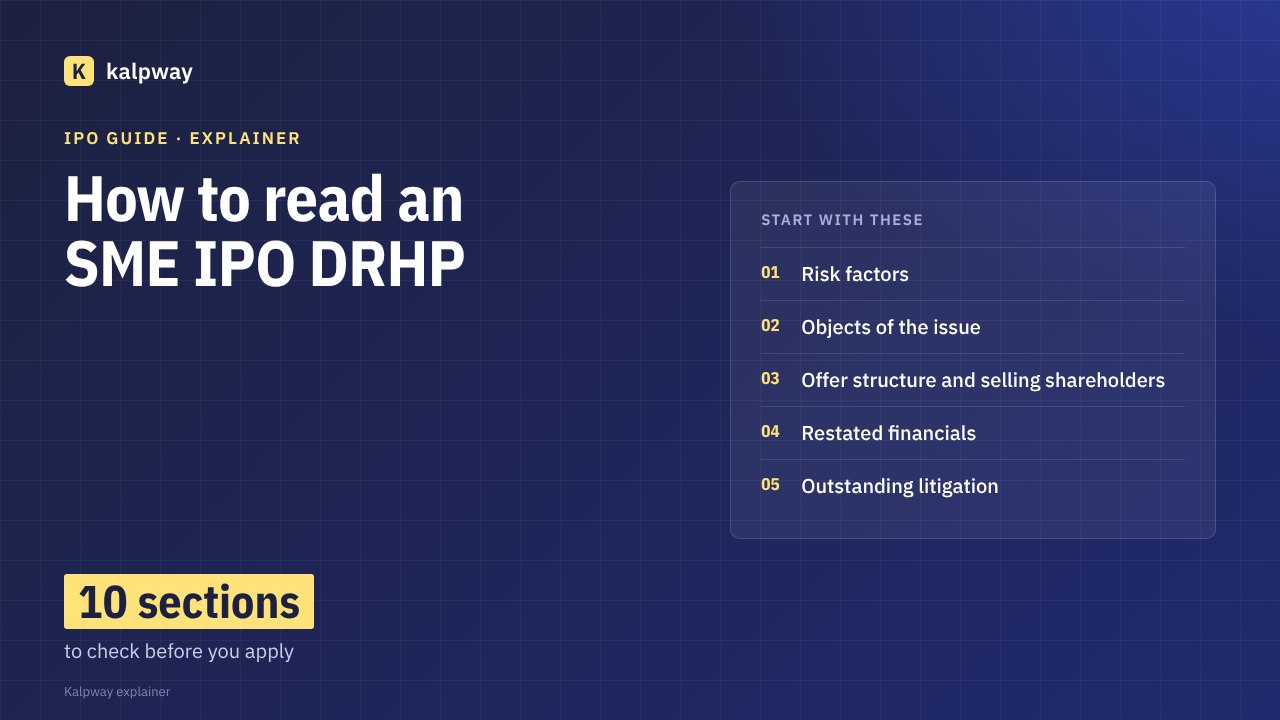
The Draft Red Herring Prospectus (DRHP) is the document in which a company explains its business, finances, risks and IPO plans before going public. For SME IPOs it is published on the SME exchange and lead manager websites and, since SEBI’s 2025 rules, must stay open for public comments for at least 21 days. You do not need to read all of it. These ten sections tell you the most.
1. Risk factors
This section lists what could hurt the business or the shares: customer concentration, dependence on a few suppliers, pending approvals, losses in a segment, regulatory exposure. Look for risks specific to this company, not generic ones that appear in every offer document.
2. Objects of the issue
This shows how the company will use the money it raises: capital expenditure, working capital, debt repayment or general corporate purposes. Under the 2025 rules, SME IPO proceeds cannot be used to repay loans from promoters, the promoter group or related parties, and general corporate purposes are capped at the lower of 15% of the amount raised or ₹10 crore.
3. The offer structure: fresh issue vs offer for sale
A fresh issue brings new money into the company. An offer for sale (OFS) lets existing shareholders sell, and that money goes to them. For SME IPOs, OFS is capped at 20% of the issue, and each seller can sell no more than half their holding.
4. Capital structure and promoter holding
Check who owns the company before and after the IPO, how much the promoters keep, recent share allotments and their prices, and lock-in arrangements. Shares issued to insiders shortly before an IPO at prices far below the IPO price are worth noting.
5. Restated financial information
The audited, restated accounts for recent years. Look at the revenue trend, operating profit (EBITDA), net profit, debt, receivables and cash flow. To qualify for an SME IPO, the company must show operating profit of at least ₹1 crore in two of the last three years, and NSE Emerge also requires positive free cash flow to equity in two of three years.
6. Related party transactions
These are deals between the company and its promoters, their relatives or their other businesses — rent, purchases, sales, loans. Large or growing related party transactions are worth understanding. Since 2025, SME-listed companies follow the mainboard rules for approving them.
7. Outstanding litigation and material developments
Cases against or by the company, its promoters, directors and group companies, including tax disputes and regulatory actions, with amounts involved where disclosed.
8. Basis for the issue price
How the company justifies its price: earnings per share, return on net worth, net asset value and key performance indicators, often with a comparison to listed peers. Check whether the peers chosen are genuinely comparable.
9. Our promoters and group companies
Who the promoters are, their experience, their other businesses, and any past regulatory issues. NSE Emerge requires promoters to have at least three years’ experience in the same line of business.
10. Market making and underwriting
SME issues must be fully underwritten and must have a market maker who will quote buy and sell prices after listing. This section names them and sets out their obligations.
A quick DRHP checklist
| Question | Section |
|---|---|
| What could go wrong for this business? | Risk factors |
| Where will the money go? | Objects of the issue |
| How much goes to the company vs existing shareholders? | Offer structure |
| Who owns what, before and after? | Capital structure |
| Is the business growing and generating cash? | Restated financials |
| How much business is done with insiders? | Related party transactions |
| What legal or tax cases are open? | Outstanding litigation |
| How is the price justified? | Basis for issue price |
| Who runs the company? | Promoters and management |
| Who will provide liquidity after listing? | Market making |
Related reading
- SME IPO in India: eligibility, SEBI rules and process
- SME to mainboard migration rules
- Kalpway IPO Tracker — with links to each issue’s offer documents