
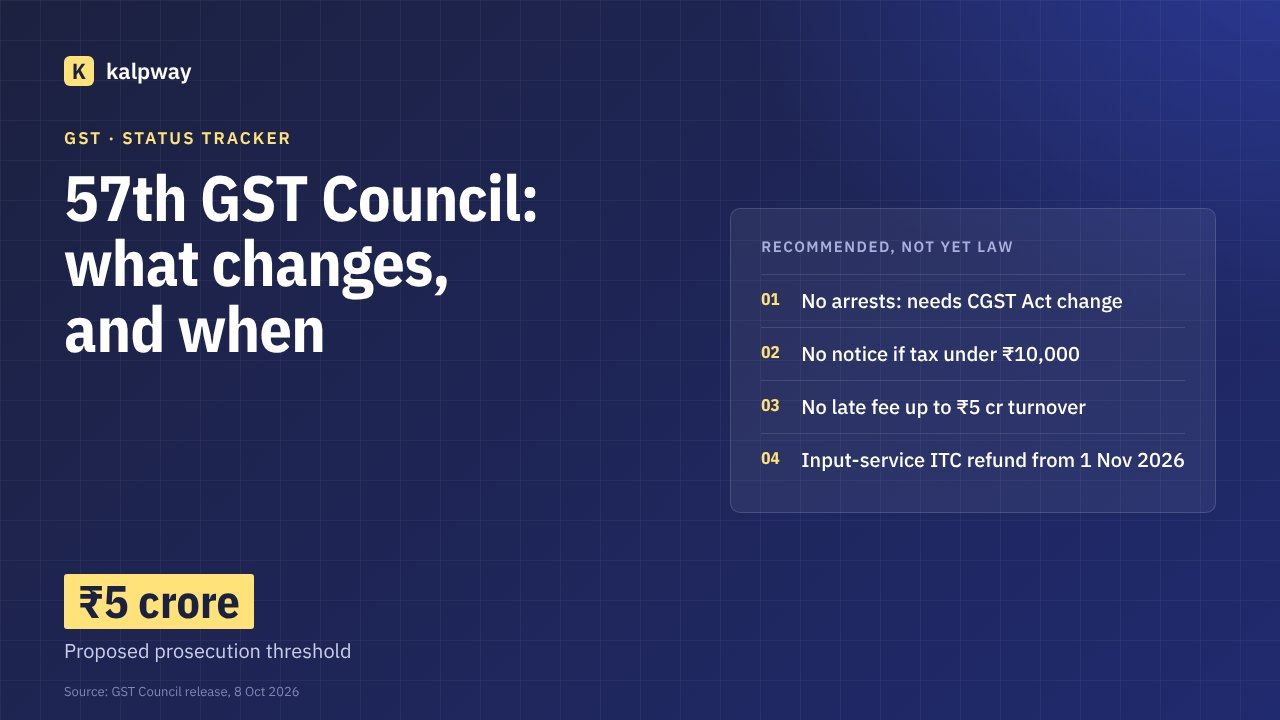
The GST Council’s 57th meeting, held on 8 October 2026, recommended five main reliefs for small businesses:
- no arrests for GST offences
- prosecution only where more than ₹5 crore of tax is involved
- no show-cause notice where the tax is under ₹10,000
- automatic refunds
- no late fee for businesses with turnover up to ₹5 crore that file within the month
None of this is law yet. Most items need Parliament to amend the CGST Act. The official release gives firm dates for only three changes.
The release says the recommendations will take effect through “circulars/ notifications/ law amendments”, “which alone shall have the force of law”. Until then, today’s rules on late fees, notices and arrest still apply. Below, Kalpway sorts each change by who it affects, the legal step it needs and the only dates the release actually names.
A note on the second official document. CBIC also published a set of FAQs on the recommendations, which is where most of the detail on rule 14B and the refund changes sits. That FAQ says of itself: “Answers are only for educational and guidance purposes and do not hold any legal validity.” It explains the proposals; it does not create them.
What did the GST Council decide for small businesses?
| Change | Who it affects | Status and legal route | Date named in the release |
|---|---|---|---|
| No arrests: section 69 omitted | All taxpayers | Recommended; CGST Act amendment | Not given |
| Prosecution only above ₹5 crore tax; fine-only option; no 6-month minimum jail | All taxpayers | Recommended; CGST Act (s.132) | Not given |
| No show-cause notice if tax under ₹10,000 | All taxpayers | Recommended; CGST Act (ss.73, 74, 74A) | Not given |
| General penalty cap ₹25,000 → ₹10,000; 5% penalty in non-fraud cases paid within 30/60 days | All taxpayers | Recommended; CGST Act (ss.125, 73, 74A) | Not given |
| No late fee if return filed by end of the month it was due | Turnover up to ₹5 crore in the preceding financial year | Recommended; route not stated | Not given |
| Optional Annual Return, Quarterly Payment (ARQP) scheme | Turnover up to ₹5 crore, B2C sales only | Concept note approved in principle | Not given |
| Register in another state using a marketplace warehouse as principal place of business | Online sellers passing on ITC up to ₹2.5 lakh a month | Recommended; new rule 14B, CGST Rules | Not given |
| Automatic acceptance of cancellation | ITC passed on never above ₹2.5 lakh in any month (or GSTR-10 filed) | Recommended (Phase 1); Act and Rules | Not given |
| Automatic refund of excess cash-ledger balance; 90% automatic provisional refund for low-risk export and inverted-duty claims | Exporters, inverted-duty businesses | Recommended (Phase 1); s.54 and Rules | Not given |
| Inverted-duty refund to cover ITC on input services | Inverted-duty businesses | Recommended | ITC availed from 1 Nov 2026 |
| Capital-goods ITC refundable over 60 months | Exporters under bond/LUT, inverted duty | Recommended | ITC availed from 1 Apr 2027 |
| E-way bill checks only on specific intelligence, approved by a Joint Commissioner or above | Anyone moving goods | Recommended; CGST Act (ss.68, 129, 130) | Not given |
Sources: Ministry of Finance release on the recommendations of the 57th GST Council meeting, 8 October 2026 (GST Council press-release page; PIB Release ID 2320934), and the CBIC FAQs on the same recommendations. “Legal route” is Kalpway’s reading of the provision each item names: a change to a section of the CGST Act needs Parliament, while a change to the CGST Rules is made by notification. The release itself does not sort the items this way. On 10 October 2026 Kalpway could not trace any notification or circular giving effect to the meeting; the Council’s press-release page lists no notification and CBIC’s own notification index is not retrievable, so this is a “not found”, not a confirmed absence.
Is any of it in force today?
No. On 8 October, Prime Minister Narendra Modi wrote: “I welcome the new round of GST reforms approved by the GST Council.” The word “approved” is doing a lot of work there. The Council’s approval is a recommendation to the Centre and the states. It is not a change in the law, and the PM’s own post went on to describe them as “the Council’s recommendations”.
PTI, as carried by The Federal and Outlook Business, reported that the changes will be implemented from 1 April 2027. Outlook Business added that they “could take about a year to stabilise”. That date is not in the official release. The release names only three dates:
- 1 November 2026: inverted-duty refunds can include ITC on input services availed from this date.
- 1 April 2027: capital-goods ITC availed from this date becomes refundable.
- The April 2027 return: a new way to correct liability and ITC “may be brought into force” from this return, after public consultation.
Even these dates describe which ITC qualifies. They are not the date the rule is notified.
Which changes need Parliament to amend the CGST Act?
The release ties these items to sections of the CGST Act, so Parliament must pass an amendment:
- arrest (s.69)
- prosecution (s.132)
- the ₹10,000 notice floor (ss.73, 74, 74A)
- the penalty cap (s.125)
- the ₹40 crore pre-deposit cap for penalty-only appeals (ss.107, 112)
- e-way bill interception (ss.68, 129, 130)
- the relaxed blocked-credit list (s.17(5))
The release does not say when an amending Bill will come, or whether it will be part of a Finance Bill. Each state’s SGST Act mirrors the CGST Act, so the states would also need to amend their own laws (Kalpway reading).
The last prosecution change shows the lag. The 48th Council recommended a higher threshold on 17 December 2022. It came into force on 1 October 2023 through the Finance Act 2023 (CBIC Notification 28/2023-Central Tax). That is about nine and a half months later (Kalpway calculation).
Rule changes such as rule 14B for online sellers, rule 86A hearings and the refund steps can move faster, because they need a notification rather than an Act of Parliament.
Was the prosecution threshold really ₹1 crore?
Only for some offences. The official release and the FAQ both say the threshold rises “from ₹1 crore to ₹5 crore”. That is a simplification of the Act as it stands.
The 48th Council, on 17 December 2022, recommended raising the minimum tax for launching prosecution “from Rs. One Crore to Rs. Two Crores, except for the offence of issuance of invoices without supply of goods or services or both”. That change was made by section 156 of the Finance Act 2023 and took effect on 1 October 2023 under CBIC Notification 28/2023-Central Tax.
CBIC’s own copy of the Act shows the result. Section 132(1)(iii), the band covering ₹1 crore to ₹2 crore, now opens “in the case of an offence specified in clause (b)” — clause (b) being invoices issued without supply. The next band up, section 132(1)(ii), starts above ₹2 crore (200 lakh rupees). So today prosecution generally starts above ₹2 crore of tax, and invoice-without-supply cases still start above ₹1 crore.
| Period | Fake-invoice offences | Most other offences |
|---|---|---|
| Up to 30 Sep 2023 | Above ₹1 crore | Above ₹1 crore |
| From 1 Oct 2023 (now) | Above ₹1 crore | Above ₹2 crore |
| 57th Council proposal | Above ₹5 crore | Above ₹5 crore |
The proposal also changes punishment to “imprisonment or fine or both”, so a court could impose a fine alone, and removes the six-month minimum sentence in section 132(3). It caps jail at two years for ₹5–10 crore and five years above ₹10 crore. None of that has happened yet: section 132(3) still requires a minimum of six months, absent special and adequate reasons recorded by the court.
What should a small trader or online seller do now?
Carry on as if nothing has changed, because legally nothing has.
- File on time. The late-fee waiver is not notified. A late return today still attracts the current late fee.
- Answer every notice, even small ones. The ₹10,000 floor is not law yet. The release says pending notices below ₹10,000 would be decided as if the floor had applied, but you should still meet current deadlines until that is enacted.
- If you have an inverted duty structure, keep your input-service invoices easy to find from 1 November 2026. Inverted duty means your input tax rate is higher than your output rate. ITC on input services availed on or after that date is proposed to count towards refunds. This is a filing-cabinet step, not a tax position: claim nothing differently and change no return until the rule is notified.
- Online sellers who want to sell into new states: wait for rule 14B. The CBIC FAQ, which has no legal force of its own, says you would need your marketplace’s decision within seven working days of applying, and that without its consent the application is deemed rejected. It also describes Aadhaar authentication and a physical check in your home state, and one registration per PAN per state. The useful thing to do today is ask your marketplace whether it plans to take part at all.
- Thinking of closing a GST registration? If you have never passed on more than ₹2.5 lakh of ITC in any month, the proposed automatic acceptance would apply to you. It is not live yet. Today’s process and the 30-day application window still apply.
What can wait until 2027?
- Capital goods: keep asset purchase records with ITC dates. Capital-goods ITC availed from 1 April 2027 is proposed to be refundable in sixty equal monthly parts. This applies to exports under bond or LUT and to inverted-duty cases, but not to exports on payment of IGST.
- Return corrections: the new mechanism for correcting liability and ITC is expected from the April 2027 return, after public consultation.
- ARQP: the Council has approved only a concept note. Eligible businesses (B2C only, turnover up to ₹5 crore) have no form, due dates or start date yet.
What is still unclear?
- Dates for most items: the release gives no dates for Phase 1 or Phase 2 of automated refunds, the notice floor, the late-fee waiver or arrest removal.
- The late-fee waiver’s legal route and reference year: the release names section 39(1) but does not say how the waiver will be given, and it says only “preceding financial year” without identifying which year will be tested once the waiver is notified. Kalpway writes financial years as FY26 for April 2025 to March 2026.
- Pending cases: the release does not say whether removing arrest powers or raising the prosecution threshold will affect cases already under investigation or in court.
- The 1 April 2027 date: the date for process reforms has been reported, not officially published.
What to watch next
- An amending Bill for the CGST and IGST Acts, and its effective-date clauses.
- CBIC notifications for rule 14B, rule 86A and Phase 1 refunds.
- The ARQP design and the consultation on return corrections.
- Whether 1 November 2026 holds for input-service refunds.
This article is general information about what the GST Council has recommended. It is not tax, legal or accounting advice, and it is not a substitute for reading the rule that finally applies to you. Nothing here tells you to change a return, a registration or a payment. Before you act on any of it, check the official release and the CBIC notification or circular that gives it effect, and take your own chartered accountant’s or tax adviser’s view on your facts.
For your registration basics, see Kalpway’s guide to MSME (Udyam) registration.