
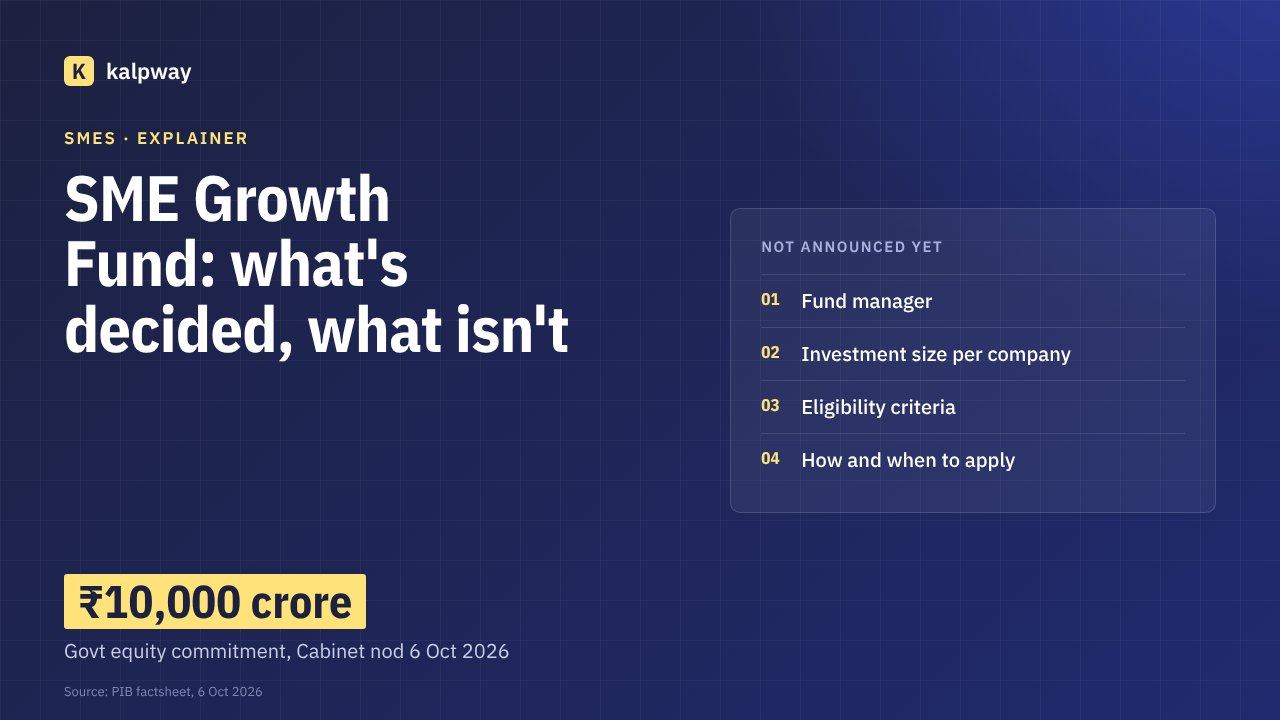
The SME Growth Fund (SGF) is a ₹10,000 crore government commitment to an Alternative Investment Fund that will take direct equity stakes in small and medium enterprises, with a major share going to manufacturers. The Union Cabinet, chaired by the Prime Minister, approved it on 6 October 2026. Neither the Cabinet press release nor the government’s factsheet names a fund manager, an investment size per company, eligibility criteria or an application route, so no SME can apply today. Here is what the documents decide, what they leave open, and why equity behaves nothing like the loans most SME owners already use.
What exactly did the Cabinet approve?
It approved a ₹10,000 crore Government of India commitment towards establishing the fund. The Press Information Bureau release of 6 October 2026 is headed “Cabinet approves Commitment of Rs.10,000 Crore towards establishment of the SME Growth Fund for direct equity investments in Small and Medium Enterprises to create future champions”. The money goes to an Alternative Investment Fund set up under the SGF framework — an AIF being a privately pooled investment vehicle regulated by the Securities and Exchange Board of India (SEBI). PIB’s accompanying factsheet calls the SGF “a direct equity investment fund”.
The Cabinet release gives the government’s own reason for a new vehicle: the equity funds it already runs mostly serve early-stage and micro enterprises, which leaves a gap at the growth stage. That gap is what the SGF is meant to fill, and it explains why the fund targets established firms rather than startups.
The stated purpose is “patient equity capital” for high-potential SMEs with demonstrated business viability and scalability. A major share of allocations will go to small and medium manufacturing-focused enterprises, and the fund will also consider SMEs in industrial clusters in Tier-II and Tier-III cities.
The money is meant for expanding manufacturing capacity, adopting advanced technologies, improving productivity, strengthening export competitiveness, acquisitions and entering global value chains. The factsheet uses the current MSME limits, under which a small enterprise has investment up to ₹25 crore and turnover up to ₹100 crore, and a medium enterprise up to ₹125 crore and ₹500 crore.
Is this the fund announced in the Budget?
Yes, on the documents’ own account. In the Union Budget 2026-27 speech of 1 February 2026, Finance Minister Nirmala Sitharaman said in paragraph 28: “I propose to introduce a dedicated ₹10,000 crore SME Growth Fund, to create future Champions, incentivizing enterprises based on select criteria.” Both the Cabinet release and the PIB factsheet place the SGF among Union Budget 2026-27 announcements. The amount, the name and the stated aim match. The Cabinet decision of 6 October 2026 is the step that turns that Budget proposal into an approved commitment.
Note the sequence, because coverage often collapses it: announced in the Budget speech on 1 February 2026, approved by the Cabinet on 6 October 2026, and not yet notified with operating guidelines. Those are three different things, and only the third would give an SME something to approach.
Paragraph 29 of the same speech proposed a separate top-up of the Self-Reliant India (SRI) Fund for micro enterprises: “I also propose to top up the Self-Reliant India Fund set up in 2021, with ₹2,000 crore to continue support to micro enterprises and maintain their access to risk capital.” A later PIB backgrounder, of 14 May 2026, describes the Budget as having “provided an additional ₹2,000 crore” to the SRI Fund. The SGF and the SRI Fund are different vehicles aimed at different sizes of business.
What is decided and what is not?
The money, the instrument and the broad focus are decided. Almost everything an owner would need in order to approach the fund is not.
| Question | Status on 11 October 2026 | What the official documents say |
|---|---|---|
| How much money? | Decided | ₹10,000 crore government commitment |
| In what form? | Decided | Direct equity, through an AIF |
| Which enterprises? | Decided in broad terms | Major share to small and medium manufacturing-focused firms |
| Which locations? | Partly decided | Tier-II and Tier-III industrial clusters “will also” be considered |
| Who manages the fund? | Not announced | No manager, sponsor or implementing agency named |
| How much per company? | Not announced | No ticket size or range given |
| Exact eligibility rules? | Not announced | Only “viability and scalability” |
| How and when to apply? | Not announced | No portal, form, process or deadline |
| Any co-investors? | Not announced | No other contributor named |
Sources: PIB Cabinet press release of 6 October 2026 (Release ID 2319532) and the PIB factsheet “Small and Medium Enterprises Growth Fund” (posted 6 October 2026, last updated 10 October 2026). Both were opened and checked term by term on 11 October 2026. The factsheet’s own last-updated stamp is four days after the Cabinet decision and still carries none of these details.
Two absences are worth naming. Neither document says who will run the fund — SIDBI, which runs the government’s startup fund-of-funds, is not mentioned, and neither is NSIC Venture Capital Fund Limited, which runs the SRI Fund. And neither says whether the ₹10,000 crore is the fund’s whole corpus or only the government’s share of something larger, as it is in the SRI Fund. The release describes it as the government’s commitment to an AIF and names no other contributor, which leaves the question open rather than answering it.
Why equity is not the kind of money SMEs are used to
Equity is ownership, not debt. An investor pays money into the company and receives shares; there is no EMI and no repayment date. The investor makes money only if the business becomes more valuable and the stake can be sold later. That one difference changes four things for an SME owner.
- You give up part of the company. A loan leaves your shareholding untouched. Equity does not.
- There is no guarantee cover. CGTMSE exists to make a lender comfortable with an unsecured loan. Nothing plays that role in an equity deal; the investor simply takes the risk and prices it.
- The investor needs an exit. Equity funds have a life. Someone must eventually buy the stake — a strategic buyer, another fund, or public investors through a listing.
- Governance changes. Equity money usually comes with reporting obligations, information rights and often a board seat.
Kalpway illustration — these are not the SME Growth Fund’s terms. The fund has published no investment size, no valuation method and no shareholding limit, and the numbers below are Kalpway’s own arithmetic chosen to show how dilution works, not figures from any document. If a fund invests ₹5 crore and both sides agree the company is worth ₹25 crore after the money is in, the fund owns ₹5 crore ÷ ₹25 crore = 20%. You repay nothing, and you share 20% of the future with someone else.
| SME Growth Fund | CGTMSE | PM Mudra | |
|---|---|---|---|
| What you get | An equity investment | A guarantee on your bank loan | A loan |
| Size or limit | ₹10,000 crore fund; no per-company figure published | Credit support up to ₹10 crore to an MSE | Up to ₹20 lakh |
| Effective from | Approved 6 Oct 2026; not operational | ₹10 crore ceiling from 1 April 2025 | In force |
| Who it is for | Small and medium firms, mostly manufacturing | Micro and small enterprises | Non-corporate, non-farm micro and small units |
| Repay on a schedule? | No | Yes — it is still your loan | Yes |
| Dilutes ownership? | Yes | No | No |
Sources: PIB Cabinet press release and factsheet (6 October 2026); DC-MSME Credit Guarantee Scheme page, read 11 October 2026, which states “With effect from 01.04.2025, this scheme facilitates credit guarantees for credit support of upto Rs. 10 crore to MSEs”; PIB, “11 Years of Pradhan Mantri MUDRA Yojana”, 8 April 2026. Mudra’s ₹20 lakh tier, Tarun Plus, is only for borrowers who have repaid a Tarun loan.
How does it fit with the government’s other equity funds?
India already runs three government-backed equity vehicles. The SGF is the first aimed squarely at established small and medium firms rather than startups or micro units, and the only one described as investing directly.
| Vehicle | Corpus | Target segment | Structure | Status | Source |
|---|---|---|---|---|---|
| Fund of Funds for Startups (2016) | ₹10,000 crore | Startups | SIDBI operates it; invests in SEBI-registered AIFs | Operating | PMO, 22 Jun 2016 |
| Self-Reliant India Fund (2021) | ₹50,000 crore (₹10,000 crore government + ₹40,000 crore PE/VC) | MSMEs; Budget 2026-27 top-up aimed at micro units | Mother fund NVCFL, a SEBI Category-II AIF, backs daughter funds | Operating since October 2021 | Lok Sabha USQ 1909, 11 Dec 2025; PIB, 14 May 2026 |
| Startup India Fund of Funds 2.0 (2026) | ₹10,000 crore | Deep tech and early-growth-stage startups | SIDBI is implementation agency; invests through AIFs | Notified 13 Apr 2026 | PIB, 13 Apr 2026 |
| SME Growth Fund (2026) | ₹10,000 crore government commitment | Small and medium enterprises, mostly manufacturing | AIF making direct equity investments; manager not named | Approved 6 Oct 2026; not notified | PIB Cabinet release and factsheet, 6 Oct 2026 |
The SRI Fund is the closest precedent and a useful reality check on pace — though the government’s own numbers for it do not agree with each other, which is worth seeing in full.
Two official documents give the amount the SRI Fund has invested as at the same date, 30 November 2025, for the same 682 MSMEs, and the figures differ by about 8.5 times.
| Official document | Date | MSMEs assisted | Amount invested | Share of the ₹50,000 crore target |
|---|---|---|---|---|
| Lok Sabha Unstarred Question 1909; PIB backgrounder “Empowering the Grassroots Economy” | 11 Dec 2025; 14 May 2026 | 682 | “more than Rs. 15,442 Crore” | 30.9% |
| Ministry of MSME Year End Review 2025 (PIB) | 30 Dec 2025 | 682 | “investment of Rs. 1,823 crore” | 3.6% |
Both documents are from the Ministry of MSME. The percentages are Kalpway calculations: ₹15,442 crore ÷ ₹50,000 crore = 30.9%, and ₹1,823 crore ÷ ₹50,000 crore = 3.6%.
Neither document says what its figure measures. The likeliest explanation is scope — the SRI Fund works through a mother fund that invests in daughter funds, 69 of which had been empanelled with NVCFL by 30 November 2025, so one figure may be the mother fund’s own commitment and the other the total the daughter funds put into companies. No official source states that, so Kalpway publishes both figures rather than picking one, and does not average them.
Either way, the pace point holds. On the higher figure the fund had deployed under a third of its ₹50,000 crore target in roughly four years of operation, since inception in October 2021; on the lower figure, well under a tenth. Government equity reaches businesses slowly, because the money moves through funds that must themselves raise, screen and invest. An SME owner waiting on the SGF should plan on years, not months.
Can you apply? Not yet
No. As of 11 October 2026 there is no scheme portal, no application form, no eligibility checklist and no stated window, and the fund has not been notified. Any website publishing “how to apply for the SME Growth Fund” steps, or any agent offering to file an application for a fee, is not working from a published official process. Kalpway will not publish an application process for this fund until one exists in an official document.
What you can usefully do now is get ready for the kind of diligence an equity investor runs, none of which is wasted if you instead raise debt:
- Be registered and classified correctly. Udyam registration is not named as an SGF condition in any document, but it decides your MSME category. Our guide to MSME registration and the current Udyam limits covers the thresholds the factsheet uses.
- Clean up the accounts. Audited financials, GST and income-tax filings that reconcile, and a clear picture of related-party transactions.
- Fix the cap table. Equity investment needs a company with clean, documented shareholding. Promoter loans and informal holdings get examined.
- Decide whether you want a partner at all. Equity costs ownership permanently; a loan costs interest for a fixed term. If the need is working capital rather than a step change in scale, debt is the route to weigh first — see our guide to business loans for MSMEs and startups and the CGTMSE route.
When operating guidelines are issued, two places are worth watching, on the precedent of the government’s other equity funds: pib.gov.in, which carried the Fund of Funds 2.0 notification release on 13 April 2026, and the administering ministry’s own site — the SRI Fund’s guidelines were published on dcmsme.gov.in. More SME policy coverage sits in Kalpway’s SMEs section.
What to watch next
- The fund manager and sponsor. Whether an existing institution such as SIDBI or NSIC runs it, or a new manager is appointed, will shape how the money is deployed.
- The operating guidelines. These will carry the eligibility criteria, the ticket size and the access route — the details missing today. Notification, not Cabinet approval, is the step that makes a scheme approachable.
- Whether private money joins. The SRI Fund’s ₹10,000 crore government share was designed to pull in ₹40,000 crore. Nothing says yet whether the SGF works the same way.
- Whether it invests directly or through other funds. The Cabinet release and the factsheet both say direct; the operating guidelines will confirm it.
This article is for general information only and is not financial, legal or investment advice. Scheme details change; check the Press Information Bureau release and the administering ministry’s notifications before acting. Facts last reviewed on 11 October 2026.