
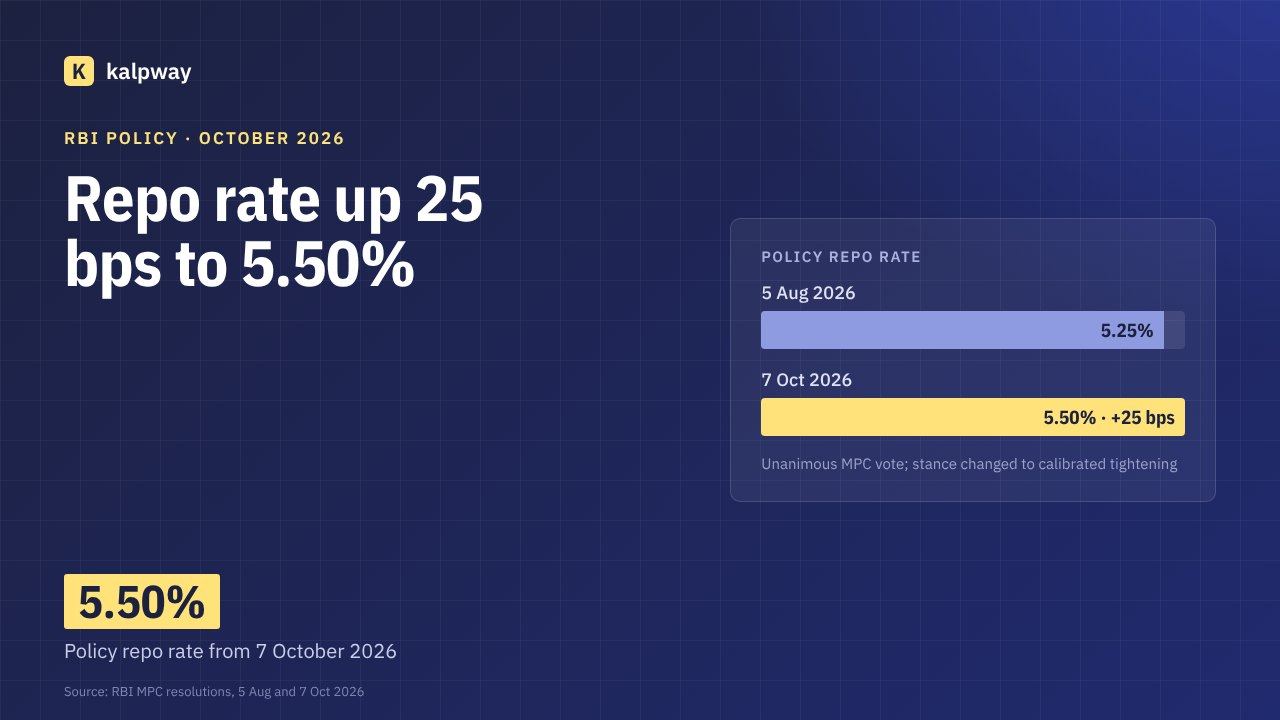
The Reserve Bank of India raised the policy repo rate by 25 basis points to 5.50% on 7 October 2026. For a small business the number that matters is not 5.50% but the reset date on its own loan: most floating-rate MSME lending by commercial banks is priced off the repo rate and must be repriced at least once every three months. On a ₹1 crore term loan over seven years, that is roughly ₹1,261 a month.
This is general information, not advice, and Kalpway does not forecast rates.
What exactly did the RBI decide on 7 October 2026?
The Monetary Policy Committee (MPC), at its 63rd meeting from 5 to 7 October 2026 under Governor Sanjay Malhotra, “voted unanimously to increase the policy repo rate under the liquidity adjustment facility (LAF) by 25 bps” to 5.50%.
| Rate | Before (5 August 2026) | After (7 October 2026) |
|---|---|---|
| Policy repo rate | 5.25% | 5.50% |
| Standing deposit facility (SDF) | 5.00% | 5.25% |
| MSF rate and Bank Rate | 5.50% | 5.75% |
| Stance | Neutral | Calibrated tightening |
The stance change was not unanimous: “Two members – Dr. Nagesh Kumar and Prof. Ram Singh – were of the view that the stance be retained at neutral.” Paragraph 14 adds that “rate cuts are off the table in the near term and policy action ahead can only be a rate hike or a pause” — the RBI describing its own framework, not a Kalpway forecast. The cash reserve ratio stays at 3.00% and the SLR at 18.00%, and the MPC projects 7.1% real GDP growth and 5.2% CPI inflation for FY27 (April 2026 to March 2027).
How does a repo rate rise reach a small business loan?
Through the external benchmark. Paragraph 25 of the Reserve Bank of India (Commercial Banks – Interest Rates on Advances) Directions, 2025 — the consolidated Direction of 28 November 2025 that replaced RBI’s earlier instructions on interest rates on advances — requires floating-rate MSME loans to be linked to an external benchmark. Paragraph 5(4) permits the repo rate, FBIL-published Treasury Bill yields and other FBIL benchmarks. The repo rate dominates: RBI’s Monetary Policy Report of April 2026 says “the bulk of the external benchmark-based loans use policy repo rate as the benchmark.” Such loans were 65.4% of scheduled commercial banks’ outstanding floating-rate loans at end-December 2025, up from 62.9% at end-June 2025.
Timing comes from paragraph 38: “the interest rate under external benchmark shall be reset at least once in three months.” That is an outer limit, not a date. The actual dates sit in the contract, and paragraph 6(5) requires the benchmark used for pricing to be stated there. So the pass-through is mechanical, but lands on the loan’s own reset date.
The spread on top is sticky by design: under paragraph 33 the credit risk premium changes “only when borrower’s credit assessment undergoes a substantial change”.
Kalpway calculation: what 25 basis points adds
Assumptions. A commercial bank’s repo-linked facility, spread unchanged at 3.29 percentage points — RBI’s reported average spread over the repo on fresh EBLR-linked MSME loans in February 2026. The illustrative rate moves from 5.25% + 3.29 = 8.54% to 5.50% + 3.29 = 8.79% at the next reset, full pass-through. Term loans run 84 months on the standard EMI formula; working-capital lines assume the full limit drawn all year. This is arithmetic, not a quote.
| Facility | ₹25 lakh | ₹1 crore |
|---|---|---|
| Working capital, extra interest a year | ₹6,250 | ₹25,000 |
| Working capital, extra interest a month | ₹521 | ₹2,083 |
| Term loan EMI at 8.54% | ₹39,642 | ₹1,58,566 |
| Term loan EMI at 8.79% | ₹39,957 | ₹1,59,827 |
| Extra EMI a month | ₹315 | ₹1,261 |
| Extra outgo over 84 months | ₹26,481 | ₹1,05,924 |
On a cash-credit limit there is no EMI to recalculate: 0.25% of the drawn amount adds to the monthly interest debit.
What does not change automatically
- Fixed-rate loans. Nothing happens. Those above three years sit outside the benchmark-linking paragraphs altogether (paragraph 45(4)(v)).
- MCLR-linked loans. They move only at their own reset. Paragraph 36, which sits in the Direction’s MCLR reset sub-section, allows a reset periodicity of “one year or lower” — so up to a year apart, even though banks publish MCLR monthly (paragraph 24).
- Lenders outside these Directions. Paragraph 3 covers “banking companies (other than Small Finance Banks, Payment Banks, and Local Area Banks)”. Small finance banks are expressly outside this instrument, and NBFCs are not covered by it either, so neither is required by these Directions to price on an external benchmark.
- Your spread. Set under the bank’s own Board-approved policy (paragraph 28), so two borrowers at one bank on one benchmark can be priced differently.
One correction, because it circulates widely: the RBI circular of 18 August 2023 — which lets borrowers switch to a fixed rate, or pick a higher EMI or a longer tenure on a reset — does not cover business loans. RBI’s own FAQ says it “is applicable to all equated periodic instalment based personal loans only” and “is not applicable to other types of loans.”
The Bank Rate moved too — and it prices a statutory MSME entitlement
The same resolution lifted the Bank Rate from 5.50% to 5.75%. Under the MSMED Act 2006, restated in paragraph 5.6 of RBI’s MSME Master Direction, the period a buyer agrees with a micro or small supplier “shall not exceed forty-five days”, and a buyer who fails to pay owes “compound interest with monthly rests … at three times of the Bank Rate notified by Reserve Bank.”
Kalpway calculation: three times the Bank Rate has risen from 16.50% to 17.25% a year nominal — an effective 17.81% to 18.68% with monthly rests. RBI publishes the Bank Rate, not the multiple, so these figures are ours. It cuts both ways: dearer to pay a micro supplier late, a stronger claim when a buyer pays you late. Disputes go to the state’s MSE Facilitation Council.
What a borrower can check in their own documents
What settles how exposed a loan is sits in the contract. Paragraph 6(5) requires that “the reference benchmark rate used for pricing the loans shall form part of the terms of the loan contract” — EBLR, MCLR, base rate or fixed. On an external-benchmark loan, paragraph 38 caps the gap between resets at three months. On an MCLR loan, paragraph 36 requires the exact periodicity to be in the contract and holds it to a year or less.
Paragraph 41 adds that eligible floating-rate term loans may move from MCLR or base rate to an external benchmark “without any charges / fees, except reasonable administrative / legal costs”.
Paragraph 4.1 of the MSME Master Direction (updated 9 February 2026) separately bars collateral on bank loans up to ₹20 lakh to micro and small enterprises — ₹25 lakh at the bank’s discretion — for loans “sanctioned or renewed on or after April 01, 2026”.
What to watch next
- 21 October 2026: the MPC minutes. The next meeting is 2 to 4 December 2026.
- How much banks pass on. RBI reports that in July–August 2026 the lending rate on fresh rupee loans “hardened by 8 bps … while it remained unchanged on outstanding loans”, with bank credit up 18.1% year on year as on 15 September 2026.
- Two things in train. NBFC Account Aggregators are to be made interoperable, “expected to be implemented by December 31, 2026”. And RBI’s draft 2026 interest-rate Directions, marked “Draft for comments”, propose effect “from April 01, 2027” — a draft is not a rule, and the 2025 Directions continue to apply.
See also Kalpway’s guide to business loans for MSMEs and startups and our complete guide to MSME registration in India 2026.
General information based on the RBI documents listed below, current as of 10 October 2026. Not legal, tax or financial advice, and not a recommendation about borrowing. Check the official sources and consult a qualified professional for your situation.