

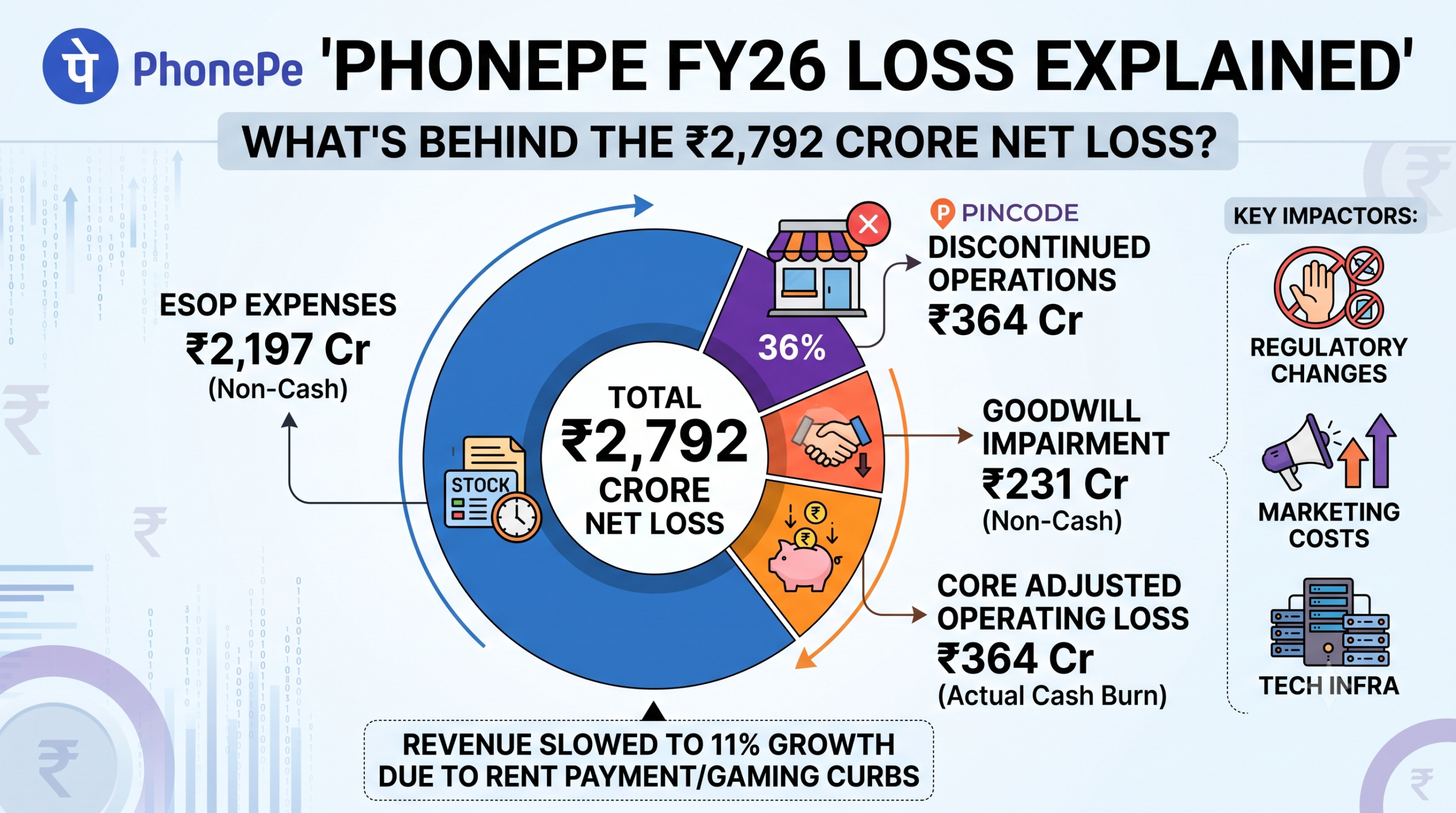
PhonePe achieved a headline-grabbing net loss of ₹2,792 crore in FY26, raising fears about future profitability even as the company managed to grow revenues for another year.
At a cursory glance, PhonePe’s financials seem really bad. But on a deep dive, the loss appears misleading, as it comes out of the operating performance of the company. Much of the reported losses could be attributed to one-time accounting adjustments rather than normal business operations.
Here’s a summary of the happenings in FY26 at PhonePe and how the investors are seeing beyond the headline loss figure.
Revenue Continues its Upward Journey
In FY26 PhonePe shows revenue from operations of ₹7,920 crore, which is about an 11.5% increase as compared to the previous year. The growth has come with the help of its expanding ecosystem, which has become more than just a digital payments player. The company has added several revenue sources in the following areas:
- Digital Payments
- Merchant Solutions
- Insurance Solutions
- Lending Services
- Wealth Management
- Financial Products
Although the pace of growth moderated compared to earlier years, PhonePe remains one of India’s largest fintech platforms with hundreds of millions of users and a dominant share of UPI transactions.
Why Was the Loss So High?
The ₹2,792 crore loss mentioned has raised eyebrows more due to accounting measures and not business losses.
Companies in the business indicate that excluding exceptional and non-operating accounting entries of PhonePe, the actual value of its losses stands at $364 crore.
The accounting measures in question here include:
Deferred taxation,
Changes in fair values,
Other one-off accounting adjustments.
Being largely non-cash accounting methods, many of these entries aren’t representative of the company’s actual business performance.
PhonePe keeps on investing heavily on expanding its fintech business.
The company has been diversifying into other businesses apart from payments services and has launched other services including insurance, lending, stock broking, and wealth management. The setup of these regulated businesses would require heavy investments in technology, compliance, and other business activities.
Though these investments have negative implications on the business at present, they are meant to help PhonePe divert its business from payments and offer new services that would be able to earn a more solid income from more customers in a longer term.
While these investments weigh on short-term profitability, they are aimed at creating diversified and higher-margin revenue streams over the long term.
Regulatory Changes Also Had an Impact
Similar to various fintech businesses, PhonePe found itself amidst a fluctuating regulatory landscape in FY26.
Hit the multiple changes that affected credit card rental payments, online gaming payments along with several kinds of payments which affected the transaction volumes in some instances, although it also slowed down the growth in some areas and aided companies to diversify their business plans.
PhonePe has kept its focus on expansion of financial services so that it can reduce its reliance on revenue from payments.
Why Are Investors Looking at More than the Headline
For fast-growing tech firms, investors tend to make a distinction between the statutory net loss figure and the revenue performance.
Rather than just focusing on the net losses, analysts typically address the importance of the factors such as:
Revenue increase
Customer engagement
Development of financial services
Improving profit margins
Achieving steps towards sustainable profitability.
Thus, according to these criteria, PhonePe is still able to show further expansion.
What It Means for PhonePe’s IPO
Market participants are anticipating PhonePe’s public listing in 2024 or the following year, and investors keep a track of its financial performance.
The FY26 results indicate that the company’s net loss was strongly affected by accounting adjustments, while its core business continues to grow.
As PhonePe continues developing its financial services business and enhancing operational efficiency, investors will be closely looking at:
Increasing revenues
Decreasing losses from operations
Higher share of financial services contribution
Steady progress towards profit
The above factors seem to be more important than any accounting adjustments when assessing the long-term outlook of the company.
Final Thoughts
PhonePe’s FY26 financial results illustrate why headline numbers do not always tell the whole story.
Although the ₹2,792 crore loss has drawn immediate attention, it is mainly due to accounting adjustments rather than any deterioration in business performance.
With revenue at ₹7,920 crore and the estimated core operating loss around ₹364 crore, PhonePe is still investing in building a bigger fintech ecosystem.
As PhonePe approaches its imminent IPO, investors are likely to be less concerned by the headline loss than its ability to generate revenue and diversify its financial services business and achieve profitability in the long run.
