
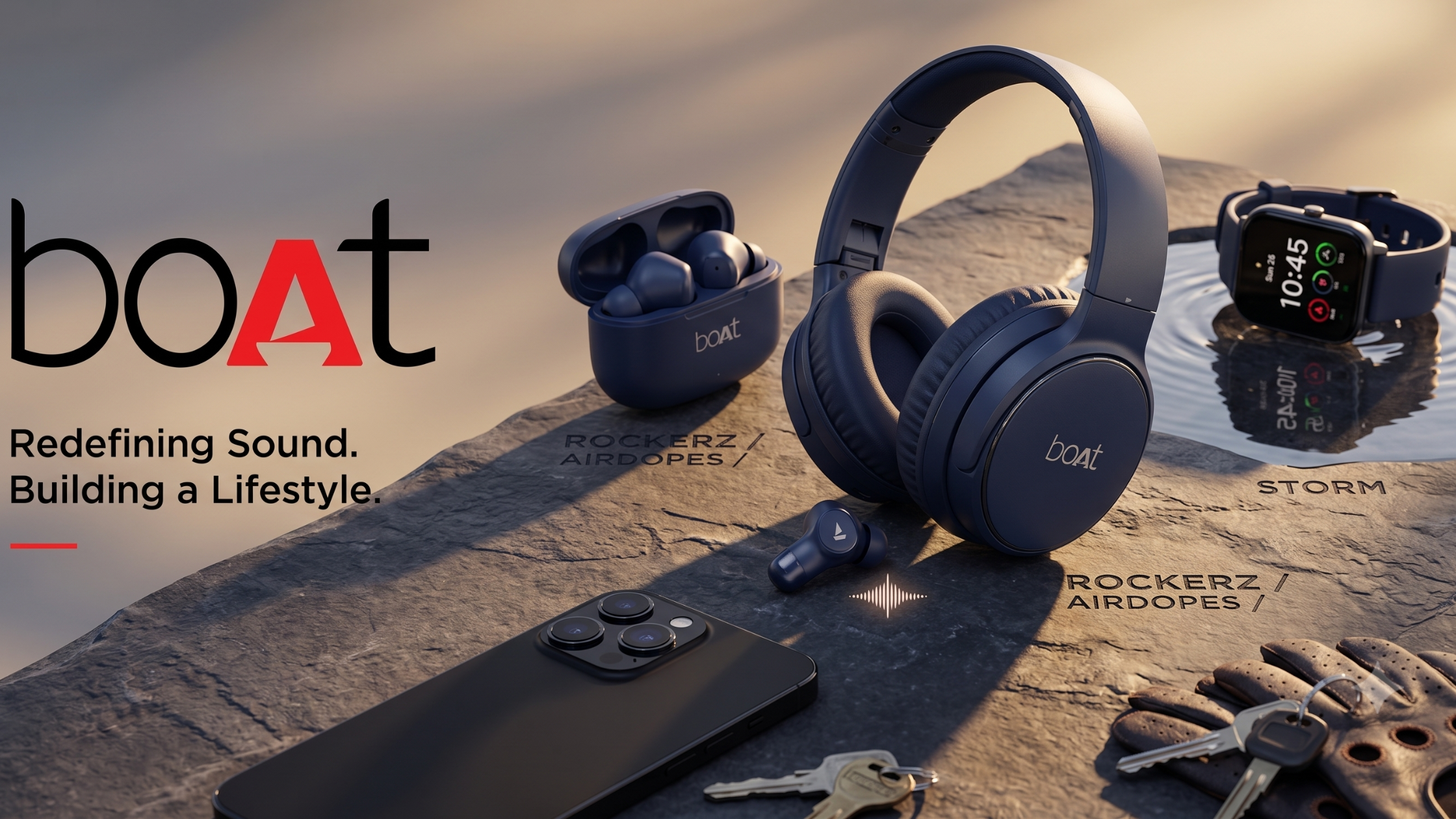
Building a homegrown consumer electronics company is not easy in a market with many well-established international brands and cheap alternatives. But boAt has succeeded in creating a strong identity with Indian consumers through a mix of affordable products, contemporary design, aggressive distribution and a keen understanding of its target audience.
Today, boAt is one of India’s most sought-after consumer electronics brands with products ranging from wireless earphones, earbuds, headphones, speakers, smartwatches to other lifestyle devices. But its journey didn’t start with a massive manufacturing operation or unlimited access to capital. It all started when two entrepreneurs saw an opening in a market that they believed wasn’t serving Indian consumers well.
The story of boAt offers valuable lessons on product positioning, branding, understanding the customer and disciplined growth.
The Beginning of boAt
boAt’s story started with its founders, Aman Gupta and Sameer Mehta. The company says the founders started their journey in 2014 after spotting demand among Indian consumers for affordable, durable and fashionable audio products.
However, after a period of research and product development, the brand was launched in 2016. During this period, the founders focused on understanding what Indian consumers really wanted rather than launching a large portfolio of products immediately.
The founders came with complementary experience to the business.
Aman Gupta had experience with finance, sales, marketing and consumer electronics. He had working experience with JBL and exposure to product management and offline distribution with retailers like Croma and Reliance Digital. Sameer Mehta joined the team with experience in technology, product development and electronics business.
This combination would matter because there was a lot more than electronic products at stake in boAt’s eventual success. The company had to understand consumers, find the right products, manage sourcing and build a brand that consumers recognized.
You can also read Zepto Success Story
The founders noticed there was a gap in the market between high-end international brands and cheaper products that often competed mostly on price.
Indian consumers wanted products that were functional but also beautiful and aspirational. They wanted headphones and earphones that looked good, worked reliably and didn’t charge a premium-brand price.
This became a significant part of boAt’s positioning.
Instead of competing with premium brands on technology or brand heritage, boAt aimed to democratize consumer electronics for India’s young and digitally savvy population.
The company says its initial goal was to make fashionable, affordable and quality audio products and accessories for India’s changing youth.
The focus provided a clear target consumer for the company.
Starting With Consumer Understanding
One of the most interesting aspects of boAt’s early journey was its focus on consumer use cases.
According to the founders their research showed consumers were looking for practical improvements like tangle-free earphones, longer cables and better designs. Also found was a desire for more power, more energy in the sound experience.
This approach was important because boAt was not just trying to build another pair of earphones.
It was about solving everyday problems and making the product look good.
That distinction helped the company move away from a commodity mindset.
Bootstrapping Before Big Funding
The founders have been talking about putting their own money into the business and having a pretty tough time trying to get investors to see the opportunity. The early years were a time to be careful with capital and inventory decisions.
The founders reportedly pitched to many investors before finding one willing to back the business. Finally, in 2018, Fireside Ventures invested in boAt.
The time period is important for the boAt story as it shows that funding was not the reason for the company’s success.
First, the business had to demonstrate that consumers would buy its products.
Revenue was part of a company’s credibility.
The Power of Affordable Premium
In a word, boAt’s product strategy can be summed up as affordable premium.
The company wanted its products to be more stylish and aspirational than ordinary low-cost electronics, but still within the reach of a broad cross-section of Indian consumers.
This positioning was particularly suited to the growing young consumer market in India.
Wireless audio equipment that looked modern and felt fashionable didn’t require a customer to spend big bucks on a premium international brand.
It was an attractive proposition.
The product didn’t have to be the most advanced technological device on the market. It had to deliver the right mix of design, function, price and lifestyle appeal that consumers demanded.
This became one of boAt’s biggest competitive advantages.
Building a Youth-Centric Brand
Many consumer electronics companies are very spec-driven.
boAt was very focused on identity.
The company knew that young consumers weren’t just buying headphones or earbuds for their function. These products were becoming more and more a part of personal style.
boAt has also established itself as a lifestyle brand and not just an electronics brand.
It appealed to younger consumers through its branding, communications and product designs. The company coined the term “boAthead” for its community of customers to underline the notion that buying the product was akin to joining a larger tribe.
That was a smart move for branding.
Instead of communicating only on technical specifications, boAt tried to build an emotional connect with its customers.
Digital-First Distribution
The growth of boAt was aided by the rise of e-commerce.
Selling online gave the company access to customers across India without needing a traditional nationwide retail infrastructure from day one.
It was well-timed. Indian consumers were taking to buying electronics online, and Amazon and Flipkart were making it simpler for emerging brands to distribute nationally.
The digital-first approach also helped boAt understand customer behavior.
It allowed the company to see which products sold, at what price points and how consumers reacted to new launches.
The brand grew, and the expansion was not just in online channels, but to physical retail as well. By 2020, boAt had thousands of retail outlets, supported by a distributor network.
This combination of online and offline presence increased the accessibility of the brand.
Marketing Became a Competitive Advantage
One of boAt’s biggest achievements was to make marketing an integral part of its product strategy.
The company knew it had to be where its target customers were.
Its speech was youthful and energetic, and closely linked to popular culture. The brand worked with celebrities, athletes, influencers and other public figures to raise awareness.
This helped boAt to get acquainted much quicker than a conventional advertising would have helped a traditional electronics company.
The strategy also built social proof.
The more musicians, athletes, entertainers and influencers were seen using a brand, the more culturally relevant it became to consumers.
It wasn’t just about making sure consumers knew boAt existed.
To make boAt a natural part of the modern Indian youth culture.
Rapid Revenue Growth
The company’s financial performance was the result of this strategy.
According to company filings cited by YourStory, boAt’s revenue jumped from around ₹27 crore in FY2017 to ₹108 crore in FY2018.
The company announced revenue of about ₹500 crore by FY2020, marking a significant increase from the previous year.
Other estimates, based on company filings, put FY2020 revenue at around ₹700 crore and profit at ₹48.5 crore, showing how quickly the business was growing then.
The exact numbers vary by entity, reporting period and accounting basis, but the broad story is clear that in a short span of time, boAt went from being a relatively tiny startup to a significant player in the consumer electronics industry.
Expanding Beyond Audio
Audio was still the heart of the brand, but boAt realized the consumer relationship could go beyond earphones and headphones.
The company expanded into categories including speakers, soundbars, smartwatches, and other wearable or lifestyle electronics.
This helped boAt to increase the products it could sell to an existing customer.
It made sense as a branding thing as well.
If consumers trust boAt for headphones, they might also consider the same brand for a smartwatch or speaker.
This opened up avenues for cross-selling and helped boAt evolve from an audio company to a wider consumer electronics brand.
The Importance of Product Speed
Consumer electronics is a fast paced business.
Technology changes quickly, consumer tastes change rapidly and products can become obsolete in fairly short periods of time.
boAt’s ability to launch products across categories helped it stay visible in the market.
Instead of a hero product, the company created a broad portfolio structured around different consumer needs and price points.
This also reduced the risk of dependence on one category.
The company’s current product portfolio includes wireless earphones, ear buds, headphones, smartwatches, home audio and other consumer electronics products.
Managing the Manufacturing Challenge
Manufacturing was one of boAt’s big challenges.
Consumer electronics needs particular supply chains, product development capabilities and manufacturing expertise. During its rapid growth the company relied heavily on contract manufacturing including manufacturing relationships in China.
This model allowed boAt to focus strongly on product selection, branding, marketing and distribution, without having to immediately build a massive manufacturing infrastructure.
As the electronics manufacturing ecosystem in India expanded, boAt increasingly focused on building local manufacturing and supply-chain capabilities. The functions of manufacturing and supply chain are now embedded in the company’s organization.
Competing With Global Brands
boAt entered a market where consumers were already familiar with brands like Sony, JBL and other international names.
Competing with these companies required a different approach.
Instead of trying to beat established brands on all technical specs, boAt focused on the things that mattered more to a younger Indian customer which is affordability, design, ease of access and cultural relevance.
That was a very strategic decision.
A startup is unlikely to be able to compete with established companies on all dimensions.
Successful startups instead, focus on the dimensions that matter most to their target customers and build an advantage there.
And that’s exactly what boAt did.
The Role of the Founders
Aman Gupta and Sameer Mehta’s complementary strengths were also an important factor.
Aman Gupta has been very active in the marketing and brand building space while Sameer Mehta has played a key role in the strategic direction, product development and operations of the company. Both are founding members and promoters, the company’s official leadership information says.
This diversity in their background enabled the company to blend commercial knowledge with product and operational expertise.
Lessons From the boAt Success Story
The boAt journey teaches entrepreneurs a lot of lessons.
Solve a Real Consumer Problem
The company began with a deep understanding of what Indian consumers want from everyday audio products. It did not assume that demand was automatically created by an advanced product.
Choose a Clear Customer
boAt knew the pulse of young India well. This clarity affected product design, pricing, communication and distribution.
Build a Brand, Not Just a Product
Earphones can be commodified. A brand can build loyalty and repeat buying.
boAt also invested heavily to create an identity around its customers that helped in product differentiation in a crowded market.
Use Distribution as an Advantage
E-commerce helped boAt reach customers quickly and the later shift to offline retail enhanced accessibility.
Be Capital Conscious
The founders early experience with limited capital required the company to focus on revenue and operational efficiency. Subsequent fundraising was underpinned by evidence of demand, not just a good presentation.
Expand Carefully
Transitioning from audio to wearables and other categories helped boAt leverage its existing brand and not create a new customer relationship from scratch.
What Made boAt Successful
There wasn’t a single reason for boAt’s growth.
Its success was due to a combination of several decisions at the right time.
The company was in a large and growing market for consumers. It discovered a disconnect between cheap products and high-end international brands. It made products based on the Indian consumer’s choices. It was an ecommerce pioneer. It developed a youth-oriented reputation and invested heavily in marketing.
Most importantly, it knew that consumer electronics is about more than technology.
It’s also about price, design, distribution, culture and brand perception.
This larger understanding helped boAt compete against much older and more established players.
Conclusion
The boAt story is a great example of how an Indian company can create a large consumer brand through deep understanding of its customers and consistent execution.
Aman Gupta and Sameer Mehta did not start their journey at the scale that boAt has become. They had an idea, personal equity, extensive market research and the belief that Indian consumers were ready for products that combined affordability with style.
From there, the company grew through product expansion, digital distribution, aggressive branding, marketing and an ever-widening consumer base.
The biggest lesson from boAt is that the most successful companies aren’t always the ones winning by creating new technology. Sometimes they win because they know a current market better than their competition.
boAt understood what a new generation of Indian consumers wanted and built a brand around those preferences. Its journey is testimony to the strength of customer insight, focused positioning and disciplined execution and powerful branding.
For entrepreneurs trying to build the next big Indian consumer brand, boAt’s journey is an important reminder that finding the right market opportunity is just the beginning. The real challenge is how to make that insight into a product people want, a brand they remember and a business that can scale.