

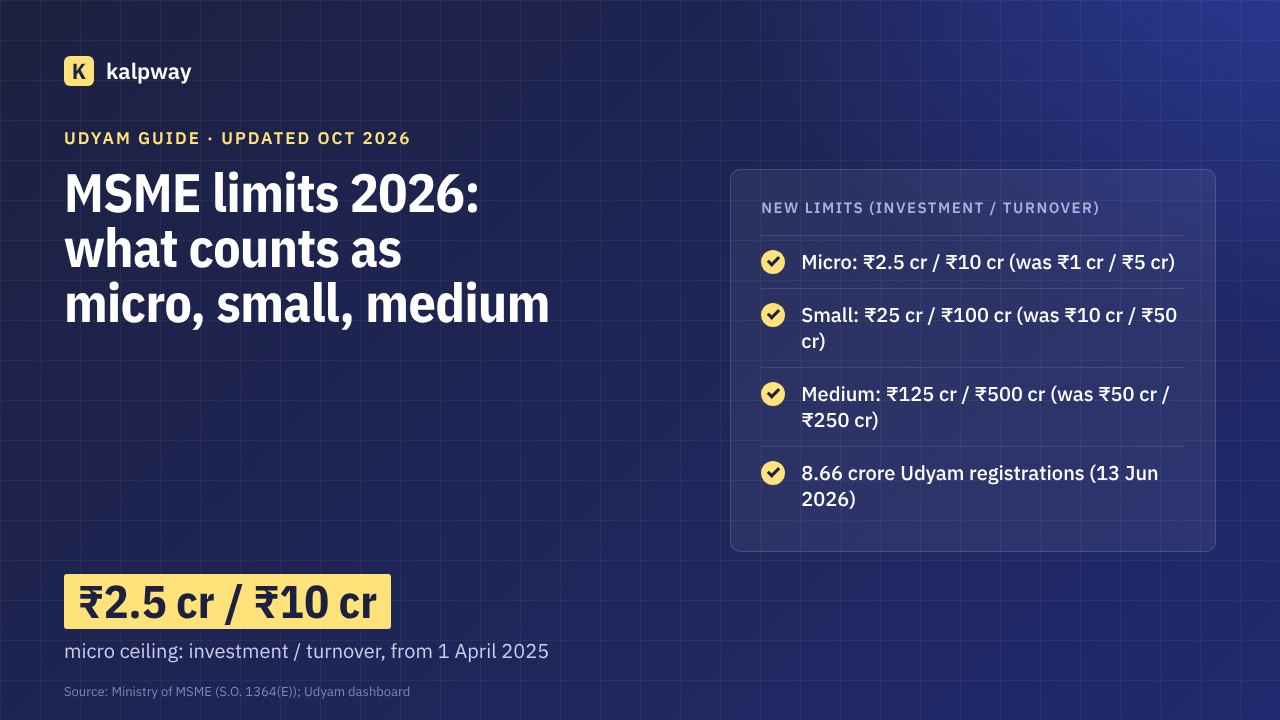
A business in India is a micro enterprise if its investment in plant and machinery or equipment is up to ₹2.5 crore and its turnover is up to ₹10 crore. These limits have applied since 1 April 2025 under Gazette notification S.O. 1364(E). Registration on the government’s Udyam portal is free. As of 13 June 2026, the official dashboard showed 8.66 crore registrations, and 99.3% of them were micro enterprises.
This guide replaces our February 2026 version, which carried the old limits. Every rule below is sourced to the Ministry of MSME, the Reserve Bank of India (RBI) or the official portal; the full source list is at the end.
What is MSME registration, and is Udyam the only official route?
MSME registration means getting a Udyam Registration Number from the Ministry of Micro, Small and Medium Enterprises (MSME). Since 1 July 2020, the Udyam portal at udyamregistration.gov.in has been the only route for most businesses. The one exception is the Udyam Assist Platform for informal micro units, covered below.
Older Entrepreneurs Memorandum (EM-II) and Udyog Aadhaar (UAM) registrations do not carry over. The portal says their holders must re-register on Udyam. The certificate carries a dynamic QR code and a permanent number that does not need renewal.
What are the MSME limits in 2026?
The limits in force on 9 October 2026 are those notified on 21 March 2025 and effective from 1 April 2025. The Budget 2025-26 speech announced the change: investment limits rose 2.5 times and turnover limits doubled.
| Category | Investment, old (₹ crore) | Investment, current (₹ crore) | Turnover, old (₹ crore) | Turnover, current (₹ crore) |
|---|---|---|---|---|
| Micro | Up to 1 | Up to 2.5 | Up to 5 | Up to 10 |
| Small | Up to 10 | Up to 25 | Up to 50 | Up to 100 |
| Medium | Up to 50 | Up to 125 | Up to 250 | Up to 500 |
Old: S.O. 2119(E), 26 June 2020. Current: S.O. 1364(E), 21 March 2025, in force from 1 April 2025. Sources: Ministry of MSME circular of 24 October 2025; RBI Master Direction on MSME lending, updated 9 February 2026.
RBI uses the same limits for bank lending. Banks therefore classify your unit on the same thresholds the ministry uses.
How is my category worked out?
Your category is decided on a composite test of investment and turnover. To qualify for a category, you must be within both of its ceilings. If you cross either ceiling, you move up a category. To move down, you must fall below both ceilings of the lower category (Ministry of MSME circular of 24 October 2025, restating S.O. 2119(E)).
Four computation rules, as set out in the 2020 notification and restated by RBI, matter in practice:
- Exports don’t count. Export turnover of goods or services is excluded from turnover. An export-heavy firm can therefore stay micro or small at a higher total turnover.
- One PAN = one enterprise. All units under the same PAN are added together.
- Investment follows your ITR. Investment is taken from the previous year’s income-tax return. A new unit that has not filed an ITR self-declares investment, using the purchase invoice value excluding GST.
- Turnover is taken from PAN and GST data. The portal says investment and turnover are pulled automatically from government databases.
Did the new limits change my category?
Units that sat near the old ceilings may have moved down a category on 1 April 2025. For example, a firm with ₹8 crore turnover and ₹2 crore investment was small under the old limits and is micro now. The ministry’s circular of 24 October 2025 says the enhanced limits apply “for all purposes” from 1 April 2025.
When a unit moves down for any reason (the notification calls this “reverse graduation”), it keeps its existing category until the financial year ends. The new category applies from 1 April of the next year. A unit that grows past a ceiling keeps its existing status until one year after the close of the year of registration (RBI circular of 2 July 2020). Because the portal takes investment and turnover from your income-tax and GST data, keep those filings and your Udyam details consistent.
What do I need to register on Udyam?
You need an Aadhaar number linked to a mobile phone for OTP verification. You also need PAN and, where GST law applies to you, a GSTIN. No documents are uploaded. The portal states that PAN and GSTIN have been required since 1 April 2021. The GSTIN requirement follows GST applicability under notification S.O. 1055(E) of 5 March 2021.
| Type of business | Whose Aadhaar | PAN | GSTIN |
|---|---|---|---|
| Proprietorship | Proprietor | Yes | If GST applies to the business |
| Partnership firm | Managing partner | Yes | If GST applies |
| Hindu Undivided Family (HUF) | Karta | Yes | If GST applies |
| Company or LLP | Authorised signatory | Yes, of the entity | Yes, subject to GST applicability |
| Cooperative, society or trust | Authorised signatory | Yes, of the entity | Yes, subject to GST applicability |
Source: Udyam registration form page and homepage, checked 9 October 2026.
Also keep handy the details of what you make or sell. You will pick National Industrial Classification (NIC) activity codes, and some NIC activities are not covered under the MSMED Act. One enterprise can hold only one Udyam registration, but you can add several activities, such as manufacturing and services, to it.
How do I register on Udyam, step by step?
The whole process happens online at the official portal and costs nothing.
- Open the official site. Type udyamregistration.gov.in yourself. Don’t follow ads or look-alike domains.
- Choose the right option. Pick “For New Entrepreneurs who are not Registered yet as MSME”, or the UAM migration option if you hold an old Udyog Aadhaar.
- Verify Aadhaar. Enter the Aadhaar number and name of the right person (see the table above), give consent, and confirm the OTP.
- Validate PAN (and GSTIN). The portal fetches PAN-linked ITR and GST data to work out investment and turnover.
- Fill in enterprise details. Choose your activity and NIC codes and give the remaining details the form asks for. Answer accurately: the portal describes registration as “based on self-declaration”.
- Submit and download. You receive a Udyam Registration Number and an e-certificate with a QR code.
If you need help, the portal says its single window systems at the MSME ministry’s Champions control rooms and at District Industries Centres (DICs) will assist with the process.
What if my business has no GST or PAN? Use Udyam Assist
Informal micro enterprises that are not registered under GST can register through the Udyam Assist Platform (UAP), launched on 11 January 2023. You can’t self-register on UAP. A Designated Agency registers you. According to SIDBI, these agencies are regulated entities such as banks, NBFCs and microfinance institutions, plus government departments, and more than 145 are on board.
RBI’s circular of 9 May 2023 says a UAP certificate is treated at par with a Udyam certificate for priority-sector lending, and UAP holders are treated as micro enterprises for that purpose. The same circular says an interface between the two portals lets a unit migrate from UAP to the main Udyam portal once it has the required documents, such as a PAN or GSTIN.
Which benefits actually need Udyam registration?
Most MSME-specific benefits depend on it, but not every scheme’s page states a Udyam requirement. The table below shows what Kalpway could confirm on official pages.
| Benefit | What it gives | Is Udyam needed? | Official link |
|---|---|---|---|
| Priority-sector lending | Banks count your loan as MSME credit | Yes: banks follow the Udyam certificate (UAP accepted) | rbi.org.in (MSME Master Direction) |
| Collateral-free bank loans | No collateral for loans up to ₹20 lakh to micro and small units (sanctioned/renewed from 1 April 2026) | The rule applies to MSE units; banks classify MSEs using Udyam | rbi.org.in |
| CGTMSE credit guarantee | Guarantee on loans to micro and small units up to ₹10 crore (from 1 April 2025) | Pages opened don’t state it; ask your lender | cgtmse.in |
| Government procurement | 25% central procurement target for MSEs; free tender sets; earnest money deposit (EMD) exemption | Yes, and only for the NIC item group you registered | dcmsme.gov.in (PPP FAQs) |
| Delayed-payment cases | File against buyers through MSME Samadhaan | Yes: valid Udyam, micro and small only | samadhaan.msme.gov.in |
| Udyam-linked credit card (announced) | ₹5 lakh limit for Udyam-registered micro units (Budget 2025-26) | Yes, per the announcement | indiabudget.gov.in |
For how these loans work in practice, see our guide to business loans for MSMEs and startups.
Three limits are worth knowing. First, procurement benefits cover goods and services suppliers, not traders. Retail and wholesale traders can register on Udyam, but only for priority-sector lending. Second, the procurement EMD exemption does not cover performance bank guarantees. Third, joint ventures cannot register on Udyam, so they cannot claim these benefits.
What protection do I get against late payments?
The MSMED Act, 2006 requires a buyer to pay a micro or small supplier within the agreed period, and that period cannot exceed 45 days from the day the goods or services are accepted. A late-paying buyer owes compound interest with monthly rests at three times the RBI bank rate. Disputes go to the state’s Micro and Small Enterprises Facilitation Council (RBI Master Direction, para 5.6).
You can start a case online on MSME Samadhaan (samadhaan.msme.gov.in), which accepts any micro or small enterprise with a valid Udyam registration. The ministry’s Champions portal also links to an online dispute resolution portal (odr.msme.gov.in) for delayed payments.
For receivables, the Samadhaan site lists three TReDS invoice-discounting platforms: RXIL, M1xchange and Invoicemart. The Budget 2026-27 speech said TReDS has made more than ₹7 lakh crore available to MSMEs.
How many businesses have registered?
The Udyam dashboard showed 8,66,45,875 registrations as of 13 June 2026. Of these, 5.00 crore were on the Udyam portal and 3.66 crore on Udyam Assist.
| Udyam factsheet (as of 13 June 2026) | Udyam portal | Udyam Assist | Total |
|---|---|---|---|
| Registrations | 5,00,01,671 | 3,66,44,204 | 8,66,45,875 |
| Micro | 4,93,73,880 | 3,66,44,204 | 8,60,18,084 |
| Small | 5,38,071 | — | 5,38,071 |
| Medium | 41,552 | — | 41,552 |
| Employment reported | 33,35,06,280 | 5,08,47,728 | 38,43,54,008 |
Source: Udyam Registration portal factsheet, timestamp 13/06/2026 10:30 AM, viewed 9 October 2026. Employment figures are self-declared at registration.
Kalpway calculations from the dashboard:
- Micro units make up 99.3% of classified registrations. Small units are 0.62% and medium units 0.05%.
- Udyam Assist accounts for 42.3% of all registrations, so informal units are a large share of the formalisation count.
- Reported employment averages about 6.7 people per Udyam-portal unit and 1.4 per Udyam Assist unit. That is consistent with Udyam Assist serving the smallest, mostly single-person businesses.
These percentages are Kalpway calculations from the official dashboard figures; see how Kalpway verifies and corrects data.
For trend, a PIB backgrounder put registrations at 7.30 crore in December 2025 (4.37 crore Udyam, 2.92 crore Udyam Assist). A Rajya Sabha reply put them at 7.83 crore on 28 February 2026.
What mistakes should I avoid?
These are the official warnings and rules that most often catch owners out:
- Paying a look-alike website. The portal and the Champions site both say “Beware of Fake Sites”. Only the government portal and Single Window Systems are authorised, and nobody may charge a fee.
- Registering twice. Each enterprise gets one registration. Add new activities to it rather than registering again.
- Picking the wrong NIC code. Procurement benefits apply only to the item group you registered for.
- Letting details drift. Investment and turnover are taken from your ITR and GST data, so keep those filings and your Udyam record consistent.
- Checking only one limit. You must be within both the investment and the turnover ceiling of a category; crossing either one moves you up.
- Using the old limits. Any guide still quoting ₹1 crore / ₹5 crore for micro is out of date.
If something goes wrong, raise a grievance on the ministry’s Champions portal (champions.gov.in).
What to watch next
- Udyam credit cards. The ₹5 lakh cards for Udyam-registered micro enterprises were announced in Budget 2025-26. Kalpway has not yet confirmed the launch status.
- TReDS changes from Budget 2026-27. The proposals are a CGTMSE guarantee for TReDS invoice discounting, mandatory TReDS for central public-sector (CPSE) purchases from MSMEs, and a GeM–TReDS link. These are announced, not yet confirmed as notified.
- SME Growth Fund. Budget 2026-27 proposed a ₹10,000 crore fund. Watch for eligibility rules, which may refer to Udyam status.
- Dashboard updates. Kalpway will refresh the registration table when the official factsheet updates.
If your business is growing towards listing, read our guide to SME IPO eligibility, SEBI rules and process. It is a separate framework from MSME classification. For the latest MSME policy and business news, follow Kalpway SMEs News.
This guide is for general information only and is not legal, tax or financial advice. Rules change; check the official portal and notifications, or consult a qualified professional, before acting. Facts last reviewed on 9 October 2026.




2 comments